0%

Table of Contents

The world of festive celebrations relies heavily on versatile decorating tools, and among these, the 260 latex balloon stands out as a cornerstone. Globally recognized for its affordability and malleability, the 260 latex balloon allows for endless creative possibilities, from simple balloon animals to complex, large-scale event decorations. Understanding the nuances of this seemingly simple product – its material properties, inflation techniques, and application potential – is crucial for event planners, entertainers, and anyone looking to add a touch of joy to any occasion.

The demand for 260 latex balloons is intrinsically linked to the growth of the events and entertainment industry. According to reports from the International Event Planning Association (IEPA), the global events industry was valued at over $841 billion in 2023, and is projected to continue expanding. Within this market, balloons represent a significant, accessible, and consistently popular decorating option. However, concerns around latex sourcing and environmental impact are driving a need for more sustainable practices and materials in the 260 latex balloon manufacturing process.

The accessibility and ease-of-use of the 260 latex balloon make it an indispensable tool for both professionals and amateurs alike. Its capacity to bring instant cheer and visual appeal makes it a staple at birthdays, weddings, corporate events, and countless other gatherings. Understanding how to select high-quality 260 latex balloons and optimize their use is essential for creating impactful and memorable experiences.

The Enduring Appeal of 260 Latex Balloons in Celebrations and Events

The Significance of 260 Latex Balloons

The Enduring Appeal of 260 Latex Balloons in Celebrations and Events

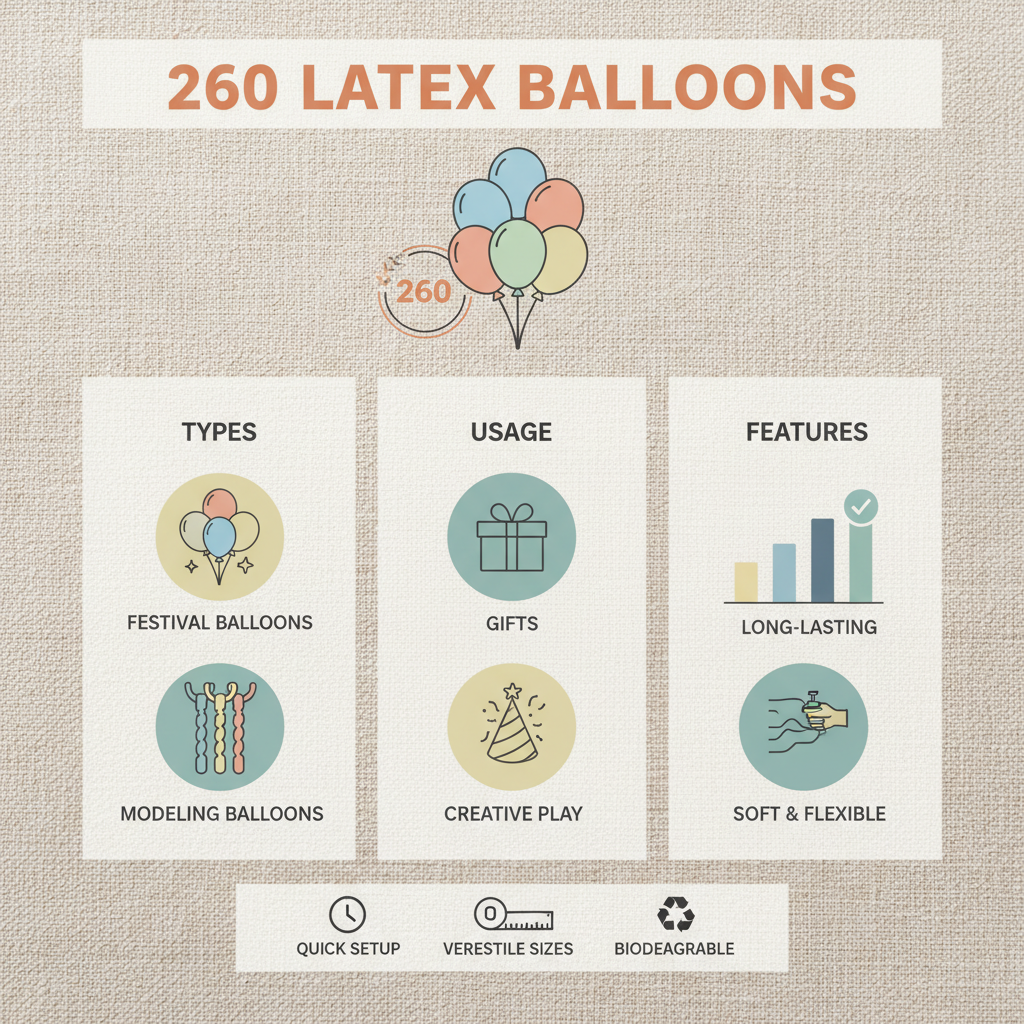
The 260 latex balloon, measuring approximately 260 inches in its uninflated length, is a staple in the balloon artistry world. Its significance stems from its unique combination of affordability, flexibility, and creative potential. Unlike traditional round balloons, the 260 allows for twisting and shaping into a myriad of designs – animals, flowers, hats, and more – making it a favorite among balloon artists and party decorators worldwide. 260 latex balloons are a versatile tool for celebrations.

This seemingly simple balloon has a substantial economic impact, supporting a global industry encompassing manufacturing, distribution, and entertainment. From small, independent balloon artists to large-scale event planning companies, the 260 latex balloon is integral to countless businesses and creative endeavors. Its consistent demand underscores its enduring appeal and practical value.

Defining 260 Latex Balloons

A 260 latex balloon is a long, cylindrical balloon typically made from natural rubber latex or synthetic materials. The '260' designation refers to its approximate length in inches when uninflated. These balloons are specifically designed for twisting and shaping, allowing artists to create intricate sculptures and designs. Their elasticity and durability make them ideal for repeated manipulation without bursting.

The connection to modern industry goes beyond mere entertainment. 260 latex balloons, and latex in general, are utilized in various industrial applications, including the manufacturing of gloves, adhesives, and medical supplies. The development of high-quality latex formulations and efficient manufacturing processes directly impacts the performance and reliability of these balloons.

In terms of humanitarian needs, latex products, including balloons, are sometimes utilized in educational programs and stress-relief initiatives, particularly in vulnerable communities. While not a primary solution, their accessibility and affordability can contribute to small-scale positive impacts.

Key Characteristics of 260 Latex Balloons

One crucial characteristic is elasticity. The 260 latex balloon's ability to stretch and return to its original shape is essential for twisting and sculpting. Higher quality latex formulations exhibit greater elasticity, allowing for more complex designs and minimizing the risk of bursting. This is paramount when creating intricate balloon animals.

Durability is another key factor. The thickness of the latex, along with its quality, determines how well the balloon withstands stretching and manipulation. Thicker balloons are generally more durable but can be harder to twist. Finding the right balance is essential for successful balloon artistry. Consider the grade of latex when selecting your 260 latex balloons.

Color Variety is vital for creative expression. 260 latex balloons are available in a vast spectrum of colors, allowing artists to match event themes, create vibrant designs, and cater to specific customer preferences. The consistency and vibrancy of the color are also important indicators of balloon quality.

Global Applications of 260 Latex Balloons

The applications of 260 latex balloons are remarkably diverse. They are prominently featured in children’s entertainment, forming the basis for balloon animals, whimsical decorations, and interactive games at birthday parties and school events. The playful nature of balloon art makes it a universally appealing form of entertainment.

In the event planning industry, 260 latex balloons are used to create stunning centerpieces, arches, and decorative installations for weddings, corporate events, and festivals. Their versatility allows for customization to match any event theme or branding guidelines.

Beyond entertainment and events, 260 latex balloons are increasingly used in promotional marketing. Companies utilize balloon art to create eye-catching displays, distribute branded balloons at trade shows, and engage customers in interactive activities.

260 Latex Balloon Applications by Region


Advantages and Long-Term Value

The primary advantage of 260 latex balloons lies in their cost-effectiveness. Compared to other decorative elements, they offer a high impact for a relatively low investment. This makes them accessible to a wide range of consumers and businesses. For event planners, maximizing budgets while delivering visually appealing results is crucial, and these balloons help achieve that.

From a sustainability perspective, advancements in latex harvesting and biodegradable latex formulations are mitigating environmental concerns. Responsible sourcing and eco-friendly disposal practices are becoming increasingly important, aligning with consumer demand for sustainable products. Choosing responsibly sourced 260 latex balloons demonstrates a commitment to environmental stewardship.

The creative potential provides long-term value, fostering innovation and artistic expression. The ability to create unique and personalized designs ensures that 260 latex balloons remain a relevant and desirable decorating option.

Future Trends and Innovation

One emerging trend is the development of biodegradable latex alternatives, aiming to reduce the environmental impact of balloon waste. Researchers are exploring new materials and formulations that offer similar elasticity and durability while being fully compostable.

Digital integration is another area of innovation. Interactive balloon art installations utilizing sensors and LED lighting are gaining popularity, creating immersive and engaging experiences. Furthermore, online tutorials and virtual balloon-twisting workshops are expanding access to balloon artistry skills.

Challenges and Solutions

A significant challenge is the environmental impact of latex waste. While natural latex is biodegradable, many balloons end up in landfills or waterways. Solutions include promoting responsible disposal practices, developing biodegradable alternatives, and raising awareness about the environmental consequences.

Another challenge is latex allergies. Individuals with latex sensitivities may experience allergic reactions upon contact with balloons. Offering latex-free balloon options and clearly labeling products are crucial for accommodating customers with allergies.

Maintaining consistent quality across different manufacturers is also an ongoing challenge. Establishing industry standards and certifications can help ensure that consumers receive high-quality, durable, and safe 260 latex balloons.

Summary of Challenges and Solutions for 260 Latex Balloons

Challenge Impact Area Proposed Solution Implementation Difficulty (1-10)
Environmental Waste Sustainability Develop biodegradable latex and promote responsible disposal. 7
Latex Allergies Public Health Offer latex-free alternatives and clear labeling. 4
Inconsistent Quality Product Performance Establish industry standards and certification programs. 6
Supply Chain Disruptions Availability & Cost Diversify sourcing and build strategic partnerships. 5
Limited Design Innovation Market Appeal Invest in R&D for new latex formulations and designs. 3
Public Perception of Balloons Brand Image Promote responsible use and environmental benefits. 8

FAQS

What is the typical lifespan of a 260 latex balloon when inflated?

The lifespan of an inflated 260 latex balloon varies based on several factors, including latex quality, ambient temperature, humidity, and how often it’s handled. Generally, a well-inflated 260 latex balloon can stay afloat for 8-12 hours with helium. Without helium, they will deflate more quickly. High-quality balloons and stable environmental conditions will yield a longer float time. Proper storage and handling also play a crucial role in extending their lifespan.

Are 260 latex balloons biodegradable, and what’s the best way to dispose of them?

Natural latex balloons are biodegradable, but the decomposition process can take months or even years, depending on environmental conditions. Synthetic latex balloons are not biodegradable. To promote responsible disposal, it’s best to deflate balloons completely and dispose of them in a regular trash bin. Avoid releasing balloons into the environment, as this poses a threat to wildlife and contributes to litter. Seeking balloons that are certified biodegradable is always a plus.

What's the difference between natural latex and synthetic latex balloons?

Natural latex is derived from the sap of rubber trees, making it a renewable resource. It's also biodegradable, though slow to decompose. Synthetic latex, also known as chloroprene, is a petroleum-based product that isn't biodegradable. While synthetic latex balloons may be more durable and less prone to allergies for some individuals, they have a greater environmental impact. Many choose natural latex for its sustainability benefits, particularly when considering 260 latex balloons.

How do I choose the right quality 260 latex balloons for twisting?

Look for balloons labeled as "260Q" or "Qualatex," as these are known for their consistent size, thickness, and elasticity. Test a small batch by inflating and twisting to check for bursting. Avoid balloons that feel overly brittle or thin. Thicker balloons are generally easier to twist and less prone to popping, especially for complex designs. Color vibrancy and uniform shape are also indicators of quality.

Can 260 latex balloons be recycled?

Unfortunately, 260 latex balloons are generally not accepted by most municipal recycling programs. This is because the latex can contaminate the recycling stream. While natural latex is biodegradable, the process is slow. The best course of action is responsible disposal in a trash bin, or seeking out biodegradable options and composting them if your local facilities allow.

What safety precautions should I take when working with 260 latex balloons?

Always supervise children when they are playing with balloons, as broken balloons pose a choking hazard. Avoid inhaling helium, as it can cause dizziness and oxygen deprivation. Be mindful of latex allergies and provide latex-free alternatives if necessary. When inflating balloons, use a hand pump or an electric inflator with a pressure regulator to avoid overinflation and bursting.

Conclusion

The 260 latex balloon, despite its apparent simplicity, remains a remarkably versatile and valuable tool in the world of celebrations, entertainment, and even promotional marketing. Its affordability, malleability, and the joy it brings to people of all ages ensure its continued popularity. Understanding its characteristics, applications, and the evolving landscape of sustainability surrounding latex production is vital for both consumers and industry professionals.

Looking ahead, innovation in biodegradable materials and responsible disposal practices will be crucial for mitigating the environmental impact of 260 latex balloons. By embracing sustainable solutions and fostering a culture of responsible use, we can continue to enjoy the magic of balloons while minimizing their footprint on the planet. Ready to explore our wide selection of 260 latex balloons? Visit our website today!

Robert Johnson

Robert Johnson

Robert Johnson is the Senior Sales Manager for North America at Han Tao. He brings a strong background in international sales and a deep understanding of the promotional products market. Robert is responsible for building and maintaining relationships with key distributors and clients. He’s particularly knowledgeable about the applications of
Previous Industrial Production and Quality of 3 latex balloon Products
Next The Global Impact and Future of 20 Latex Balloons in Celebrations
Welcome To
Tell Us Your Needs

Welcome friends and customers at home and abroad to cooperate sincerely and create brilliance together!

Consult nowConsult now